Adding carton flow to existing pallet rack is one of the most practical upgrades available to warehouse and distribution operations. It doesn't require tearing out infrastructure or redesigning a facility. It works with what's already there, converting static rack locations into gravity-fed flow lanes that keep product at the pick face, support FIFO inventory rotation, and reduce the motion and effort required to complete every pick.
The results are real: faster picks, fewer errors, cleaner replenishment workflows, and better use of storage space that already exists. But realizing those results depends on more than simply dropping carton flow into a bay. A successful retrofit requires understanding where carton flow will have the greatest impact, how the existing rack needs to be evaluated, what the SKU profile demands, and how the system should be configured around the products and workflows it needs to support.
The following steps walk through each of those decisions in detail.
Step 1: Identify Where Carton Flow Will Deliver the Greatest Impact
Not every location in a facility is an equally good candidate for carton flow. The strongest opportunities are typically found in active picking areas where products move frequently, order volume is high, and workers are spending unnecessary time reaching, searching, or traveling between pick locations. These are the areas where the gap between current performance and potential performance is largest, and where carton flow will close that gap fastest.
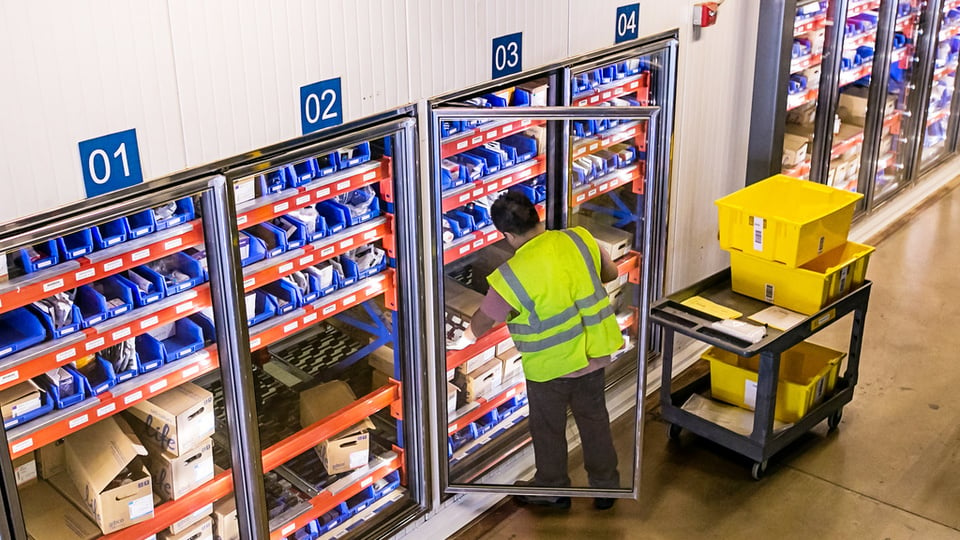
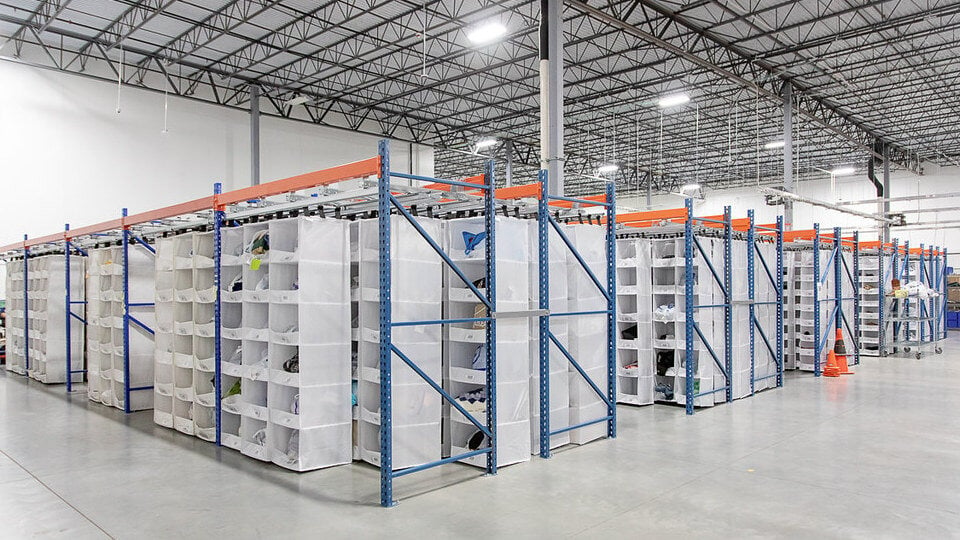
Carton flow is commonly used across each picking, case picking, pick modules, warehouse storage, manufacturing supermarkets, lineside storage, and distribution operations. What these applications share is a need for product to be consistently available at the pick face and for replenishment to happen without disrupting the picking workflow. Carton flow addresses both by advancing product forward automatically and allowing the rear of the rack to be restocked independently from the pick aisle.
Most facilities don't convert everything at once. A more effective approach is to target the highest-throughput areas first, the fast-moving SKUs, the locations where picking bottlenecks show up most often, and the zones where workers are compensating for poor product presentation with extra effort. Concentrating the initial investment in these areas produces the most visible productivity gains quickly, builds organizational confidence in the solution, and creates a clear basis for expanding the retrofit over time.
Step 2: Evaluate Your Existing Rack Configuration
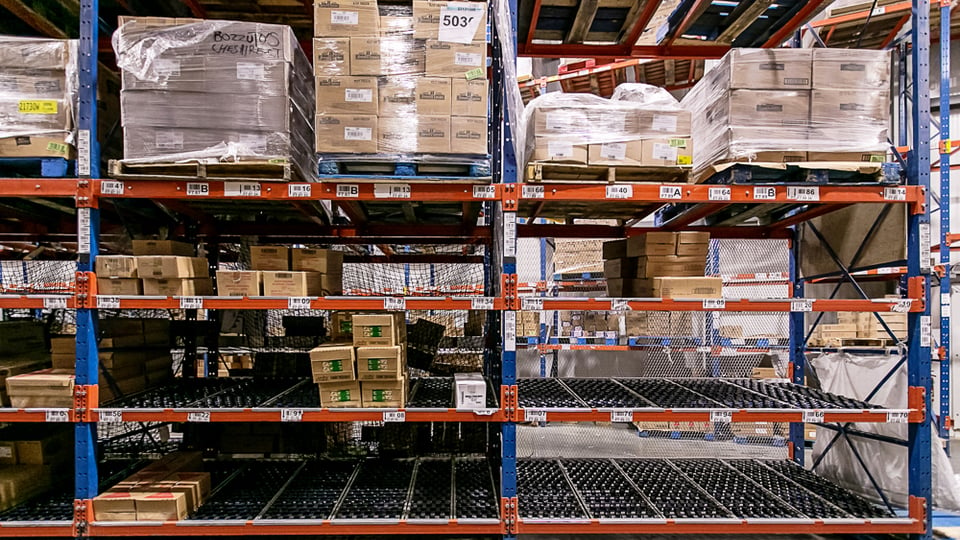
Once the target areas are identified, the next step is a detailed evaluation of the pallet rack that will support the carton flow system. Rack depth, bay width, beam spacing, available pick face heights, and replenishment access all influence how carton flow should be configured and what the system will be able to support.
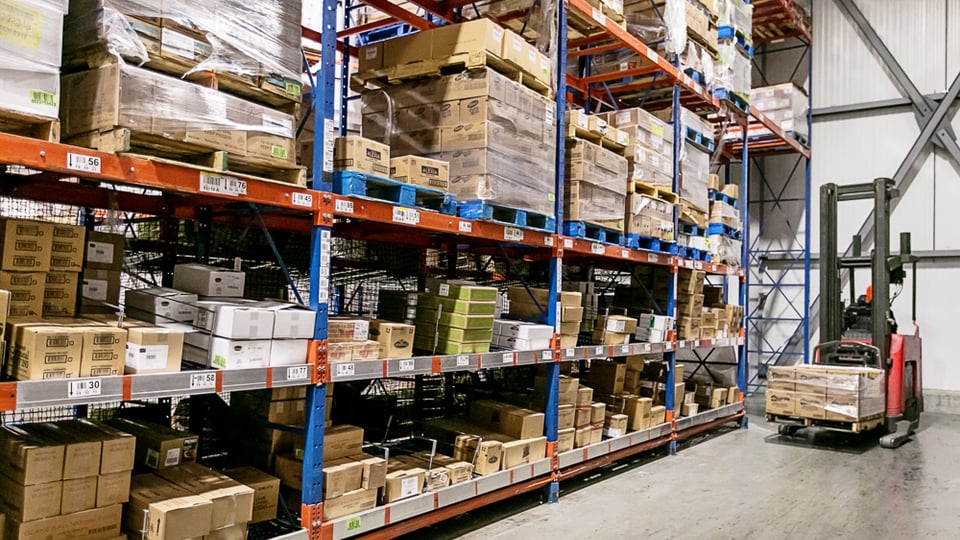
In many facilities, carton flow is installed on lower rack levels to create efficient, ergonomic pick faces while upper levels continue to serve as reserve or overflow storage. In others, entire bays or pick modules are converted to carton flow to maximize pick face capacity across the full height of the structure. Neither approach is universally correct. The right configuration depends on the specific facility, the product mix, the throughput requirements, and how workers move through the pick zone.
This evaluation should also account for how the existing rack is used throughout the day. Pick height matters because it directly affects how quickly and accurately pickers can access product. Reach distance matters because unnecessary extension slows picks and contributes to fatigue over a full shift. Replenishment access matters because a system that's difficult to load consistently will be underloaded, reducing its effectiveness regardless of how well it was designed.
The goal of the rack evaluation isn't just to confirm that carton flow can be installed. It's to understand how the system should be installed to improve the specific picking and replenishment conditions that exist in those locations today.
Step 3: Understand Your SKU Profile and Store Items According to Throughput
Before selecting a carton flow solution, it's worth stepping back to ask a more fundamental question: which SKUs actually belong in carton flow in the first place? The answer comes down to throughput, and getting this right is one of the most important decisions in any retrofit project.
In most warehouses, SKUs fall into three throughput categories. Fast movers, typically around 20% of SKUs, drive the bulk of order volume and need to be immediately accessible, easy to replenish, and in constant rotation. Medium movers make up the majority of daily picks and benefit most from dynamic storage that keeps product at the pick face without requiring manual intervention. Slow movers are picked infrequently and don't need a prime position in the pick path.
Each throughput tier has a storage medium that serves it best. Very fast movers are often best handled directly from pallet positions rather than being broken down and re-slotted. A pallet flow solution keeps product in full-case quantities, enforces FIFO rotation, and eliminates the double handling that comes with moving high-velocity product onto individual lanes. Fast to medium movers are where carton flow delivers its greatest value. Products picked frequently enough to justify a dedicated pick face, but not so fast that they're better left on a pallet, are ideal carton flow candidates. Slow movers may not be suited for carton flow at all, depending on the specific needs of your operation. Dedicating flow lanes to low-velocity SKUs can often waste prime pick face real estate and create lanes that sit full for long periods. High-density storage solutions are better suited to slow movers, compressing those SKUs into a smaller footprint and reserving carton flow positions for the products that actually justify them.
Applying this throughput framework before configuring a carton flow retrofit ensures that the right products end up in the right storage medium. It also directly informs the choice between dedicated roller lanes and wheel beds. When it comes to carton flow, medium movers with stable, predictable slot assignments are strong candidates for SpanTrack Lane. Medium movers in environments where SKU locations shift frequently due to seasonal demand, changing product mixes, or evolving customer requirements are better served by SpanTrack Wheel Bed, which allows lane positions to be adjusted across the shelf without hardware changes.
For a deeper look at how to assign SKUs to the right storage medium based on throughput, we’ve covered the full framework in detail.
Step 4: Choose Between Carton Flow Rollers or Wheel Beds
SpanTrack Lane and SpanTrack Wheel Bed are both designed to retrofit into existing pallet rack, but they are engineered for different operational requirements. Choosing between them comes down to the type of cartons you’re storing, how they are stored, how often slotting changes, and what the operation needs most from its carton flow system.
SpanTrack Lane
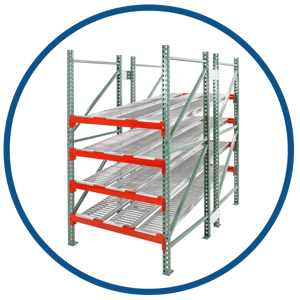 SpanTrack Lane uses full-width aluminum or steel rollers to create dedicated flow lanes with strong, consistent surface contact across a wide range of carton sizes and weights. The roller design provides significantly more product contact than traditional plastic wheel rail systems, which reduces hang-ups, supports reliable forward movement, and helps cartons present cleanly at the pick face every time.
Because SpanTrack Lane creates fixed, dedicated lanes, it works best in operations where SKU locations are stable and the slotting strategy doesn't change frequently. Fixed-slot environments benefit from the precision and reliability of a dedicated lane: each SKU has a defined home, the lane is configured around that product, and the system can be optimized for consistent throughput over time. SpanTrack Lane supports both case picking and each picking applications and is available in light-, standard-, and heavy-duty configurations to match the load requirements of the application.
SpanTrack Wheel Bed
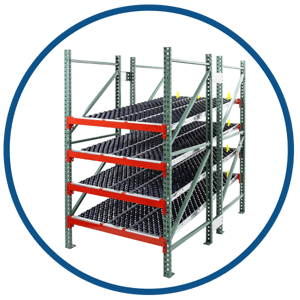 SpanTrack Wheel Bed takes a different approach. Instead of dedicated lanes, it floods an entire level of pallet rack with a field of staggered hex hub wheels, creating a flexible flow surface that can accommodate cartons of varying widths side by side on the same shelf level. Lane positions can be adjusted left to right without tools or hardware changes, making re-slotting fast and straightforward.
This flexibility makes SpanTrack Wheel Bed particularly well suited for 3PL, omnichannel distribution, and other dynamic fulfillment environments where inventory mix, SKU locations, and product dimensions change regularly. Rather than reconfiguring hardware every time the slotting strategy changes, teams can simply reposition product within the wheel bed and continue picking. Shark fin infeed guides snap onto axles to organize replenishment lanes and keep product loading clean from the rear of the rack.
Both SpanTrack Lane and SpanTrack Wheel Bed are available in custom widths and to-the-inch lengths to fit existing rack configurations, are freezer/cooler rated to below zero, and carry a 7-year warranty.
Step 5: Configure the System for the Application
Selecting the right carton flow solution is only part of the design work. Configuring it correctly for the specific application is what determines how well the system performs in practice.
Carton flow systems can be equipped with a range of accessories to improve organization, picking efficiency, and replenishment. Lane guides, guardrails, and dividers help maintain clearly defined SKU locations. End stops keep product properly positioned at the pick face and prevent cartons from exiting the lane. Impact zones and ramp stops manage flow speed for heavier loads.
Pick-face ergonomics deserve particular attention. For each picking applications, knuckled end treatments improve sight lines and make it easier to access cartons at the front of the lane. Pick trays can be added to open cases and present product at a more comfortable angle, reducing the reach and effort required for every pick. In high-volume picking environments, these details add up. A pick face that's easier to work with means faster picks, less fatigue, and better accuracy across the shift.
The right combination of accessories doesn't just make the system more comfortable to use. It makes the system easier to maintain, easier to replenish, and more consistent in its performance as volumes change and SKU profiles evolve.
Step 6: Plan for Picking, Replenishment, and Installation
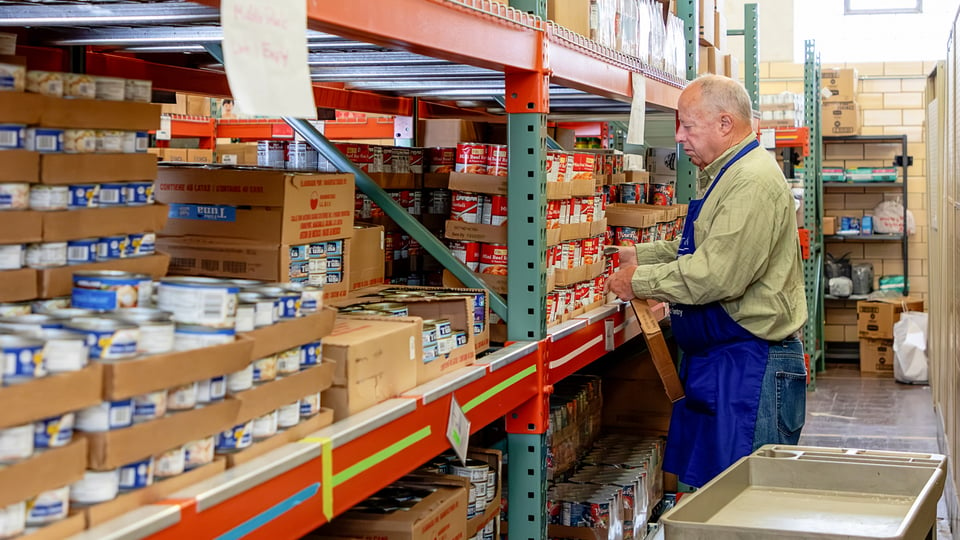
Carton flow delivers the most value when picking, replenishment, and installation are planned as a single integrated process rather than as separate tasks. In a properly designed carton flow system, product is loaded from the rear of the rack and flows forward automatically as cartons are picked from the front. This separates replenishment and picking activity into distinct workflows that can operate simultaneously without interfering with each other.
That separation is significant. In operations where pickers and replenishment teams are competing for access to the same aisle at the same time, throughput suffers and workflow becomes unpredictable. Carton flow eliminates that conflict by design, keeping the pick aisle clear for pickers while allowing the replenishment aisle to be restocked continuously throughout the shift.
Before installation, facilities should confirm rack dimensions, review replenishment access, assess how material handling equipment moves through the area, and determine how the retrofit will integrate with existing workflows. These details are easy to overlook during planning and difficult to work around once the system is installed. Addressing them in advance ensures the retrofit improves daily operations from day one rather than creating new friction points that need to be resolved after the fact.
Working with an experienced carton flow expert simplifies this process considerably. UNEX provides free engineering support on every project and partners with a nationwide network of material handling distributors to support design and installation. From evaluating rack layouts and configuring flow lanes to selecting accessories and planning replenishment access, UNEX works through the details of each application to ensure the system is designed to perform.
Why SpanTrack Is the Right Choice for Existing Pallet Rack
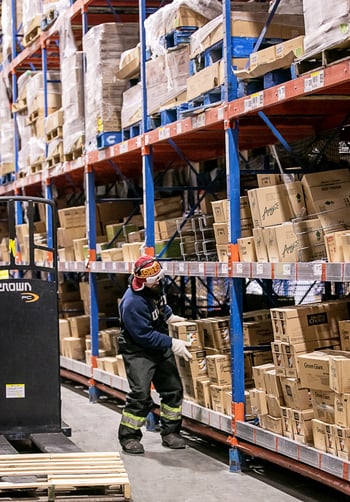 SpanTrack Lane and SpanTrack Wheel Bed were specifically engineered to retrofit into existing pallet rack, which means operations can add carton flow without replacing storage infrastructure or committing to a major capital project. The drop-in design works with new or existing rack, requires no intermediate shelves or additional support, and can be installed without disrupting surrounding operations.
SpanTrack Lane's full-width roller design delivers more surface contact than plastic wheel rail alternatives, which translates directly into more consistent carton flow, fewer hang-ups, and more reliable product presentation at the pick face. For operations with stable SKU profiles and defined slotting strategies, that consistency is a meaningful operational advantage.
SpanTrack Wheel Bed brings the same gravity-fed performance with the added benefit of left-to-right slotting flexibility. As inventory requirements change, lane positions change with them, without any hardware modifications. For operations managing diverse or frequently shifting product mixes, that adaptability is what makes the system viable long-term rather than just effective on day one.
Both solutions support the full range of carton flow applications across food, beverage, distribution, manufacturing, and retail environments, and both can be configured with the lane guides, dividers, end stops, pick trays, and other accessories needed to meet specific operational requirements.
How to Add Carton Flow to Existing Pallet Rack: Step-by-Step Quick Guide
Adding carton flow to existing pallet rack starts with understanding where the system will have the greatest operational impact and then designing the solution around the products, rack structure, and workflows it needs to support. Here is a quick summary of the steps covered above:
- Identify high-throughput picking areas where carton flow can improve product accessibility, reduce travel, and support more efficient order picking.
- Evaluate the existing pallet rack, including rack depth, bay width, beam levels, pick face locations, and replenishment access.
- Review SKU profiles to understand carton sizes, product weights, packaging types, order velocity, and inventory turnover.
- Choose the right carton flow solution based on whether the operation needs dedicated flow lanes or flexible left-to-right slotting.
- Configure the system with the appropriate lane layout, accessories, end treatments, pick trays, dividers, guides, and stops.
- Plan picking, replenishment, and installation to ensure the retrofit integrates smoothly with existing workflows.
- Work with UNEX to finalize a carton flow design that improves space utilization, supports throughput goals, and maximizes the value of existing pallet rack.
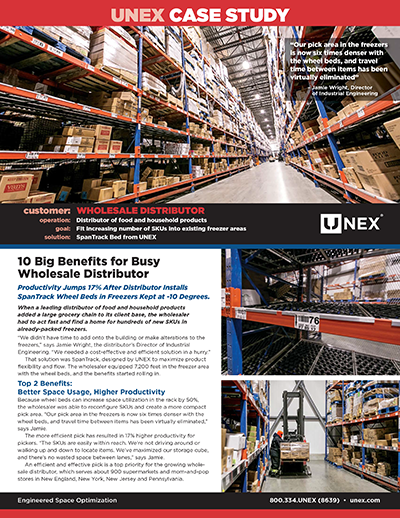
Learn how SpanTrack helped this wholesale distributor maximize space and expand operations. Download the Case Study.
Partner with UNEX to Add Carton Flow to Existing Pallet Rack
A carton flow retrofit done well doesn't just improve picking. It changes how an operation functions, separating replenishment from picking, bringing product reliably to the pick face, enforcing FIFO without process overhead, and creating a storage environment that supports throughput rather than limiting it.
UNEX carton flow experts can help evaluate your application, recommend the right SpanTrack configuration, and design a system built around your operation's specific throughput, inventory, and picking requirements. Whether the project involves a single picking zone or a facility-wide optimization, the goal is the same: a carton flow system that delivers measurable performance improvements from day one and continues to perform as the operation grows.
Contact UNEX today to learn how SpanTrack Lane and SpanTrack Wheel Bed can help increase space utilization, improve picking performance, and maximize the return on your existing pallet rack investment.