Retail and eCommerce fulfillment operations are being asked to manage increasingly complex inventory and order profiles within a finite amount of space. An order might be picked in a large distribution center, an eCommerce fulfillment facility, a micro-fulfillment operation, or the backroom of a retail store, then shipped directly to a customer, sent to a store, staged for local delivery, or prepared for pickup.
Regardless of where fulfillment happens, the physical challenge is similar: employees need fast access to a growing and constantly changing assortment of inventory. As SKU counts increase and order profiles change, pick locations can spread farther apart, employees spend more time traveling between products, and fast-moving SKUs require more frequent replenishment. Slow movers can also consume valuable pick space, while storage configurations designed around yesterday's assortment may struggle to accommodate today's demand.
Adding more space or labor can provide temporary relief, but it doesn't necessarily address the underlying problem. For retail and eCommerce operations, a more useful question is how much productive picking the operation can support within its existing space. Improving that number requires looking beyond storage capacity alone and considering how inventory, space, and people work together.
Why Pick Density Matters in Retail and eCommerce Fulfillment
Order picking is where inventory strategy becomes physical work. Every time an employee walks to another aisle, searches for a SKU, reaches into deep shelving, waits for replenishment, or moves one product to access another, time is spent without picking another item.
For that reason, picking speed depends on much more than how quickly an employee can remove a product from its location. The distance between picks, visibility and accessibility of inventory, pick-face capacity, and replenishment frequency all influence how much productive work is completed during a shift.
This is where the distinction between storage density and pick density becomes important. A storage system may hold a large amount of inventory but still make picking inefficient if products are difficult to find or access. Effective pick density puts more useful SKU locations within an employee's working area while keeping those products organized, visible, and easy to reach.
That’s particularly important in eCommerce and omnichannel fulfillment environments, where employees may need to visit numerous SKU locations to complete orders. The same principle applies on a smaller scale in retail backrooms, where employees may receive products, replenish the sales floor, process returns, and fulfill online orders from the same constrained space.
Rather than asking employees to move faster through an inefficient environment, retailers can design the environment to require less movement in the first place. Goodwill Industries of Central and Southern Indiana, Darn Tough Vermont, and Cutter & Buck demonstrate how different approaches to storage and space optimization can reduce unnecessary movement, improve pick-face capacity, and create greater flexibility for growth.
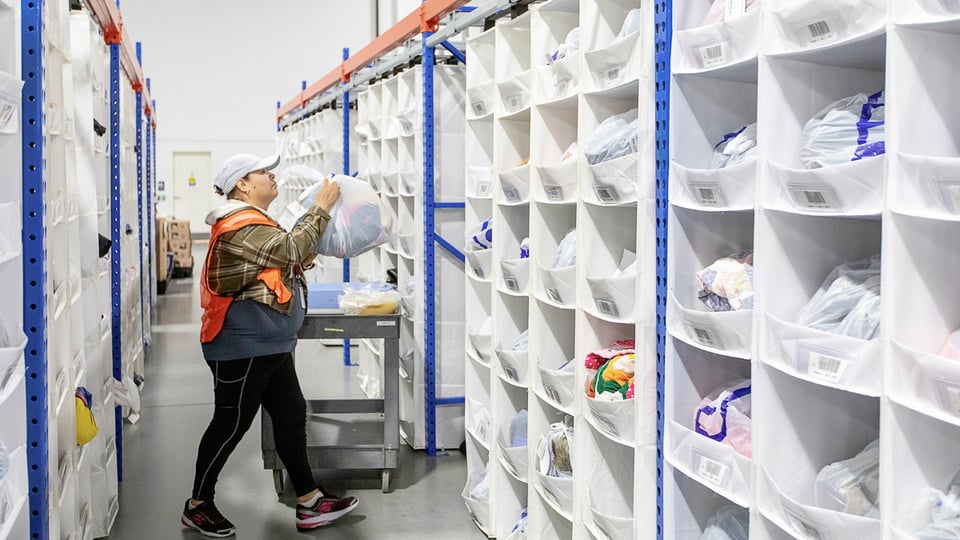
Goodwill: Eliminating Miles of Movement From eCommerce Fulfillment
For Goodwill Industries of Central and Southern Indiana, continued eCommerce growth was putting increasing pressure on both storage space and workflow. Its Indianapolis eCommerce facility handles an unusually diverse assortment of merchandise, from golf shoes and guitars to clothing, jewelry, purses, collectibles, and other products sold through its website.
By the end of 2022, that growth had created a clear need to redesign the facility for better flow and future capacity. Expanding the building wasn't an option, so Goodwill needed to store significantly more inventory within the space it already had while also making that inventory easier for employees to access.
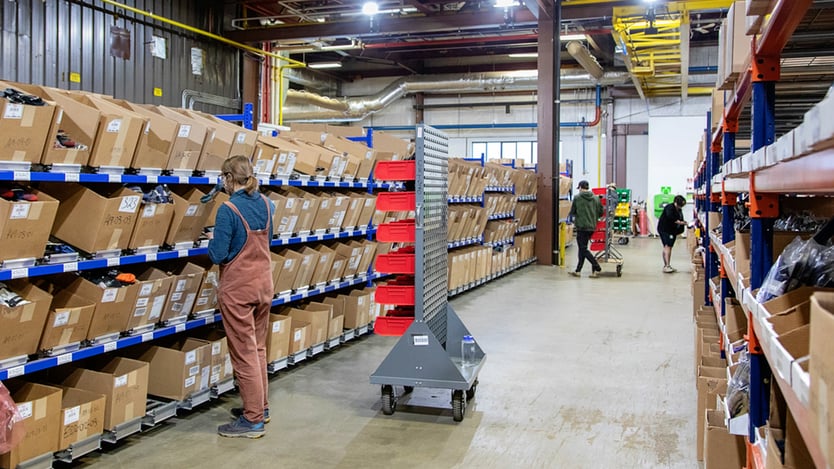
The existing workflow created unnecessary movement throughout the operation. Employees walked 10 to 15 feet to store products after inspection, while pickers and material handlers took additional steps throughout their work. Some products were stored on top of shelving, creating deep picks for employees, while other static rack space wasn't being fully utilized.
Goodwill redesigned the facility's workflow and evaluated how its storage environment could better support the new layout. SpeedCell high-density storage became part of the solution, with 1,806 SpeedCell locations installed to create 252 columns across 13 new bays. The result was more usable, accessible storage that positioned inventory closer to the people handling it.
The impact was significant. The redesigned workflow and storage reduced walking by 1.6 miles per day for shelving associates, one mile per day for pickers, and another half-mile per day for material handlers. Altogether, Goodwill eliminated more than 3.1 miles of non-value-added movement every day. At the same time, the ShopGoodwill.com team increased production from 800 items per day to 1,000. In contrast, reduced task time and unnecessary walking reduced wear and tear on employees and improved their daily experience at the facility.
Goodwill's experience demonstrates why picker travel should be viewed as a storage and workflow problem as much as a labor problem. When employees routinely travel long distances between inventory locations, simply asking them to pick faster addresses the symptom rather than the source of the inefficiency. Increasing accessible pick density and positioning inventory closer to the work can eliminate unnecessary movement and let more of each shift be spent on productive tasks.
Learn how Goodwill of Central & Southern Indiana leveraged SpeedCell to increase storage capacity by 30% and eliminate over 3 miles of non-value-added employee movement.
DOWNLOAD THE CASE STUDY
Darn Tough: Putting More Inventory Behind Every Pick Face
Reducing the distance between SKUs is one way to make picking more efficient, but travel isn't the only activity that takes employees away from productive picking. For high-velocity products, the amount of inventory available at each pick face can also determine how much time an operation spends replenishing instead of fulfilling orders.
Darn Tough Vermont experienced that challenge as demand for its socks continued to grow. The company ships more than 9 million pairs annually, and growth eventually put significant pressure on its original Northfield, Vermont, mill, where manufacturing, storage, picking, packaging, and shipping had shared the same facility.
Darn Tough ultimately moved its order fulfillment operation to a 60,000-square-foot facility in Waterbury, Vermont, giving both fulfillment and the original mill more room. The new facility ships approximately 3,000 pairs of socks on a typical day, with that number climbing to as many as 15,000 pairs during the holidays. Supporting that volume required the company to rethink how inventory was stored and presented to employees.
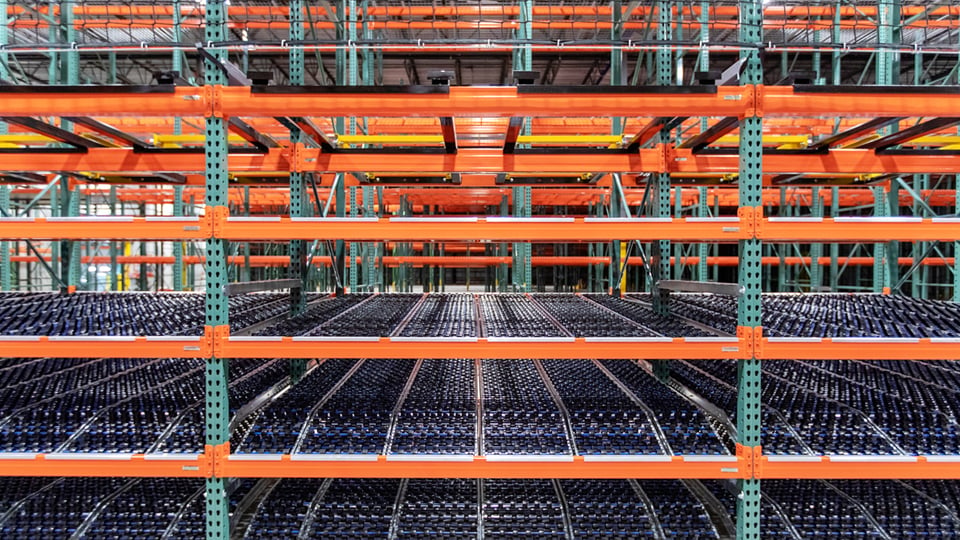
The operation incorporated 70 feet of SpanTrack Wheel Bed facings with lanes dedicated to individual SKUs. Knuckled end treatments improved product visibility and made it easier for employees to access products from totes. Darn Tough also installed nine bays of FlowCell, with four levels per bay and seven lanes per level, and identified 250 of its fastest-selling sock SKUs for placement in the system.
That increased the amount of inventory available at the point of pick dramatically. As Logistics Manager Steve Rozendaal explained, locations that previously held 30 units could now accommodate 300 units, 10 times more inventory in the pick space. The additional capacity significantly reduced replenishment time and freed employees to spend more time picking.
The distinction matters because replenishment and picking are operationally connected. Every time a high-velocity pick face runs empty, another task has to occur before productive picking can continue. If a SKU moves quickly enough, a location with insufficient capacity can create a continuous replenishment burden even if the individual pick itself is fast.
Darn Tough's experience demonstrates that a productive pick face should do more than make inventory easy to reach; it should also hold enough inventory to sustain the rate at which that SKU is being picked. Increasing usable storage depth for fast movers can reduce replenishment frequency, allowing employees to spend more of their time fulfilling orders.
The approach proved useful beyond fulfillment. Darn Tough later implemented similar storage solutions in production and packaging, using SpanTrack and FlowCell to improve inventory visibility, accessibility, storage utilization, and product flow in other parts of the business.
Learn how Darn Tough Vermont leveraged UNEX SpanTrack and FlowCell to optimize production, storage, picking, and packing while shipping more than 9 million pairs of socks each year.
DOWNLOAD THE CASE STUDY
Cutter & Buck: Designing Flexibility Into a High-Growth Distribution Center
Retail operations also need to consider how today's storage decisions will perform when tomorrow's assortment looks different. New styles are introduced, seasonal products move in and out, carton sizes change, and demand can shift quickly from one SKU to another. A highly efficient storage system therefore needs to provide density without locking the operation into a rigid configuration.
That flexibility was an important consideration when Cutter & Buck developed its Canadian distribution center in Brampton, Ontario. The active lifestyle apparel company wanted to create a fast, efficient, technologically advanced facility that could serve Canadian customers with a lean staff while providing room for future growth.
The 75,000-square-foot distribution center was designed to support approximately 1 million golf shirts, hoodies, rain jackets, and other apparel items across 25,000 distinct pick locations. The operation incorporated more than 4,000 SpanTrack Wheel Beds to organize and move that inventory efficiently.
Approximately 42,000 square feet of the facility was dedicated to the SpanTrack storage environment, while the remaining 33,000 square feet was initially reserved for future growth. The Wheel Beds provided more than capacity alone; products could be replenished from the back while employees continued picking from the front, inventory remained organized and accessible, and daily inventory tracking could occur without disrupting the pick operation.
That combination of organization, density, and flexibility helped Cutter & Buck create an operation that could accommodate growth without requiring space to increase at the same rate. The distribution center was exceeding its original performance expectations and expected to expand two to three years sooner than initially planned.
The broader lesson is that maximum density today doesn't necessarily equal maximum efficiency tomorrow. Retail inventory assortments rarely remain static, so storage needs to accommodate changes in SKU dimensions, velocity, and demand without rebuilding the entire pick environment. For retail and eCommerce operations, flexibility should be considered part of space utilization.
Learn how Cutter & Buck leveraged more than 4,000 SpanTrack wheel beds to maximize cubic density and keep a lean staff picking efficiently across 25,000 distinct pick locations.
DOWNLOAD THE CASE STUDY
What Faster Retail and eCommerce Picking Looks Like
Although Goodwill, Darn Tough, and Cutter & Buck operate very different businesses, their experiences point to a common principle: storage should reduce the work around every pick.
Reduce Travel Before Trying to Increase Pick Speed
Goodwill's results make the relationship between travel and productivity especially clear. Eliminating more than three miles of daily non-value-added movement didn't require employees to walk faster; it required redesigning the workflow and putting more inventory closer to the people doing the work.
In person-to-goods fulfillment environments, distance between locations can significantly affect productivity because those movements repeat throughout every shift. Consolidating SKUs into a smaller, accessible picking area can increase the percentage of an employee's time spent handling products rather than traveling between them.
Put More Inventory Where the Work Happens
Darn Tough illustrates another dimension of pick density. Increasing certain pick locations from 30 units to 300 reduced how frequently those locations needed to be replenished, allowing employees to spend more time picking.
For fast movers, a shallow pick location may save space but can create extra work if employees must continually refill it. Effective pick-face design therefore needs to consider both the number of SKUs in the pick zone and the inventory each SKU needs to support its velocity.
Match Storage to SKU Velocity
Not every product deserves the same amount or type of pick space. Fast-moving products benefit from highly accessible locations with enough depth to sustain picking between replenishments, while slower-moving products can often be consolidated into denser storage without consuming large amounts of prime pick-face space.
Combining different storage approaches can therefore be more effective than forcing every SKU into the same configuration. The goal is to give each inventory category enough space to support its movement while keeping the overall pick path as compact as possible.
Design for Change
Cutter & Buck's experience demonstrates why flexibility matters alongside density. A storage layout needs to support current SKU dimensions and demand while still making it practical to re-slot inventory as the assortment changes.
This becomes especially important in retail environments affected by seasonality, promotions, new product introductions, and changing fulfillment channels. Storage density remains valuable only if the operation can use it effectively as products and priorities change.
Design Around the Employee
Better storage utilization should also make the work itself easier. Darn Tough used knuckled pick faces to improve product visibility and accessibility, Goodwill reduced the physical burden of miles of unnecessary walking, and Cutter & Buck viewed its efficient, safer pick environment as an advantage when competing for employees.
Whether employees are working in a large eCommerce fulfillment center or a constrained retail backroom, inventory should be organized around how people actually interact with it. Products that are easier to see, reach, replenish, and identify can reduce unnecessary motion while supporting both productivity and a better working environment.
Storage Solutions for Retail and eCommerce Operations
There is no universal storage configuration for retail and eCommerce fulfillment. SKU count, product dimensions, velocity, order profiles, replenishment frequency, available space, and whether products are picked by the case or as individual units all influence the right design.
For many operations, the most effective approach is to use different storage solutions for different inventory profiles rather than expecting one system to handle every SKU equally well.
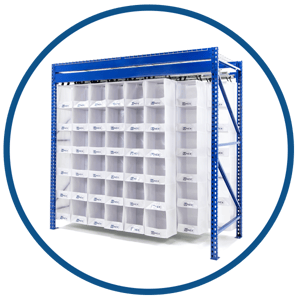 SpeedCell High-Density Storage
SpeedCell creates high-density storage while maintaining individual, accessible locations for each SKU. Sliding columns allow multiple rows of storage to fit within the depth of a pallet rack, making the system particularly well-suited to slow- and medium-moving, each-pick inventory where many SKUs must remain accessible within a limited footprint.
For eCommerce fulfillment centers and retail backrooms, that density can help consolidate inventory and shorten the distance between locations without simply stacking more products onto conventional shelving. Goodwill demonstrates the opportunity: increasing storage density became more valuable because the redesigned environment simultaneously positioned products closer to employees and reduced unnecessary movement.
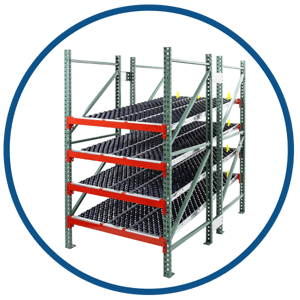 SpanTrack Carton Flow
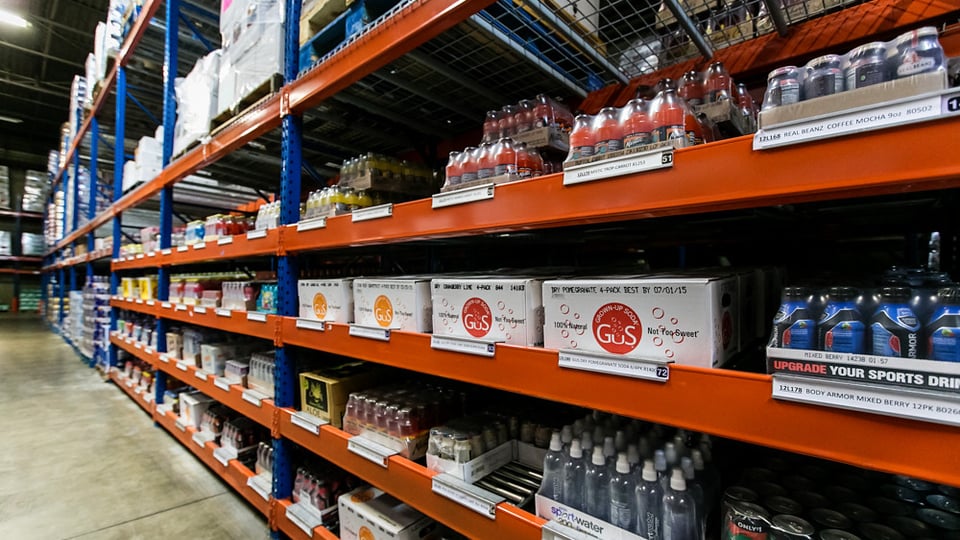
SpanTrack carton flow uses gravity to move products continuously toward the pick face. Inventory is picked from the front and replenished from the rear, keeping products readily accessible while reducing interference between picking and replenishment.
For retail and eCommerce operations, SpanTrack can support full-case and each picking applications, while Wheel Bed configurations provide additional flexibility when product dimensions or SKU locations change frequently.
Cutter & Buck used SpanTrack Wheel Beds across thousands of pick locations to create a flexible, organized fulfillment environment, while Darn Tough used Wheel Beds to provide dedicated lanes for individual SKUs and improve product presentation at the point of pick.
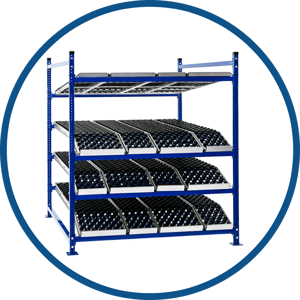 FlowCell Modular Flow Racks
FlowCell provides modular, gravity-fed storage for picking, packing, kitting, assembly, and replenishment processes. Because the system can be adjusted and reconfigured as requirements change, it can create dedicated pick areas while maintaining flexibility as SKU profiles and workflows evolve.
At Darn Tough, FlowCell concentrated 250 of the company's fastest-selling sock SKUs into productive pick locations. Increasing the amount of inventory available at those locations reduced replenishment requirements and helped employees spend more time picking.
The bigger opportunity is not to maximize any single storage solution, but to match storage to the work. High-density storage can consolidate slower-moving each-pick inventory, carton flow can keep higher-velocity products continuously presented to employees, and modular flow racks can create dedicated work areas for fast-moving inventory and fulfillment processes.
Make the Space Between Picks More Productive
Retail and eCommerce fulfillment will continue to evolve as SKU assortments change, demand fluctuates, and customers move between home delivery, store pickup, local delivery, and traditional shopping. The challenge for operations teams is creating a physical environment that can support those changes without requiring space, labor, and travel to increase at the same pace.
Goodwill demonstrates what can happen when inventory is brought closer to employees, eliminating miles of unnecessary movement while increasing daily output. Darn Tough shows how putting more inventory behind high-velocity pick faces can reduce replenishment requirements and keep employees focused on picking. Cutter & Buck demonstrates the importance of combining density with flexibility so an operation can accommodate new products and continued growth without requiring a proportional increase in its footprint.
Together, these operations reinforce an important principle: picking speed is ultimately a result of design. When the right inventory is positioned closer to employees, fast-moving pick locations hold enough product to sustain demand, and storage can adapt as the assortment changes, employees spend less time walking, searching, reaching, and replenishing.
For retail and eCommerce operations trying to increase throughput without continually adding labor or square footage, better space utilization creates an opportunity to make every pick location, every step, and every square foot work harder.
Contact UNEX today to learn how dynamic storage solutions can help your retail or eCommerce operation improve picking efficiency, increase storage density, and create a more flexible fulfillment environment.